


Does a tech and entrepreneurship degree that combines both exist from day one? If you’ve asked yourself that question, you’re probably stuck between two worlds: engineering and code on one side, building your own company on the other. Most academic advisors will tell you to pick one. But what if that choice is a false dilemma?
Some students want to understand how artificial intelligence works and know how to build a business around it. They want to create apps and lead teams. They’re not interested in just coding or just managing — they want to do both at once, with purpose and real impact.
This article explains what options exist in Spain to study tech and entrepreneurship in a single university degree, what you’ll actually learn in each, and why the hybrid tech-entrepreneur profile is one of the most in-demand in today’s job market. According to the World Economic Forum’s Future of Jobs 2025 report, creative thinking, technology literacy, and leadership are the three most sought-after skills for 2030 — exactly what a strong tech and entrepreneurship degree should develop.
The False Dilemma: Engineering or Business?
When a high school student says they like technology, the near-automatic response is: «Study computer science or telecommunications.» And when they say they want to start a company, they get pointed toward Business Administration or Economics. What almost never gets asked is the right question: what happens if you want to do both, and do them well?
The 21st-century job market doesn’t separate «the tech people» from «the business people.» The world’s most successful startups — from Stripe to Notion, plus dozens of Spanish references — were founded by people who understand both product and business. Chief innovation officers at large companies need to speak the language of code and the language of business results. As a result, profiles that master only one of the two worlds become dependent on the other.
The real problem isn’t that tech and entrepreneurship degrees don’t exist. The problem is that very few deliver on both from day one, in a practical way.
Why Engineering Alone Isn’t Always the Answer
Studying computer engineering or telecommunications has enormous value if your calling is deep technical work: systems architecture, advanced programming, networks. However, the vast majority of engineers who want to start companies confirm the same thing when they graduate: «I know how to build the product, but I don’t know how to sell it, lead it, or scale it as a business.»
Why Business Administration Doesn’t Solve the Problem Either
Business Administration offers a solid foundation in finance, marketing, and strategy, but its methodology is mostly theoretical and technology contact is usually limited to one or two elective courses in digital transformation. Real automation tools, artificial intelligence, or product development rarely get hands-on time. The result: many students finish the degree knowing how to explain what a startup is but having never built one.
What Tech and Entrepreneurship Degrees Exist in Spain?
Before making a decision, it’s worth knowing the real options out there. In Spain, the main formats for combining tech and entrepreneurship are:
- Double degrees in Engineering + Business Administration: they combine both areas, but with a heavy theoretical load in each. They typically last 5 to 6 years and move at a demanding pace with little room for personal projects.
- Business Tech or Digital Business degrees: they mix digital management with applied technology, but depth varies widely depending on the university.
- Leadership, Entrepreneurship, and Innovation degrees: focused on creating real companies during the degree itself, with technology integrated as a strategic tool from year one.
The key difference between these options isn’t just the curriculum — it’s the methodology: are you going to learn about technology by reading manuals, or by using it in real projects with real clients?
Comparison Table: Options for Studying Tech and Entrepreneurship
| Aspect | Engineering + Business Admin (double) | Business Tech Degree | LEINN (TeamLabs/) |
|---|---|---|---|
| Duration | 5–6 years | 4 years | 4 years |
| Methodology | Theoretical with internships at the end | Variable, theory-practice mix | Real projects and companies from year 1 |
| Applied technology | High on technical side, low on business side | Medium, tool-focused | AI, automation, no-code applied to your own projects |
| Real entrepreneurship | Marginal or nonexistent | Simulations and case studies | Central axis: you create companies and invoice real clients |
| Team leadership | Not worked systematically | Partially | Core of the program, from day one |
| International experience | Voluntary Erasmus | Varies by program | Mandatory Learning Journeys (Finland, Costa Rica, South Korea, India…) |
The Myth That Holds Back Many Tech Students
There’s a widespread idea worth dismantling right away: «To work in tech, you need to study engineering or code from scratch.»
That’s not entirely true in 2025. The tech world has transformed radically. With no-code tools like Airtable, Notion, Webflow, or Lovable, with automation platforms like N8N, and with the explosion of generative artificial intelligence, it is now possible to build tech products and businesses without writing a single line of code.
What you do need — and what is most scarce — is the ability to understand what problem technology solves, lead a team that develops it, and turn it into a real value proposition for the market. That’s not learned in an engineering degree alone. Nor in a traditional business degree.
The most valuable profile is not the pure programmer or the pure manager: it’s the person who can speak both languages and make them understood by each other. That is, ultimately, the profile that a good tech and entrepreneurship degree builds.
How LEINN Works Tech and Entrepreneurship from Year One
LEINN is the official university degree from TeamLabs/, accredited by Mondragon Unibertsitatea (University of Mondragon), which has been training entrepreneurs in Spain for over a decade. Its pedagogical model, the Mondragon Team Academy Model (MTA Model), puts technology at the heart of business learning — not as an isolated course, but as a strategic tool integrated into every project.
Tech Skills: The Technology Foundation from Year One
From the first year, all LEINNers take a range of Tech Skills courses. Among them is «Emerging Technologies,» designed to build a shared foundation in technology and digitalization. It’s not studied through memorization: content is discovered through individual and team challenges that students apply directly to their real projects. In year two, that knowledge expands and deepens.
Tech in Bizz: Technology Applied to Real Businesses
One of the most powerful programs in the LEINN experience is Tech in Bizz, an intensive five-week program where teams work with AI-powered growth tools, no-code automation, and technology integration, applying them directly to their own projects. Tools like N8N, Airtable, Replit, and Lovable stop being a foreign language and become allies for growth.
The philosophy of Tech in Bizz is precisely what defines LEINN’s approach to technology: it’s not about LEINNers becoming technicians — it’s about becoming leaders who understand technology as a competitive advantage.
Technological Learning Paths and Peer Learning
Each LEINNer builds their own learning track through Learning Paths: applied work in which they research how to use a tool or methodology, apply it in their project, and document real results. Some of the most popular ones relate to digital marketing, growth hacking, sales automation, and data analytics.
In addition, the LEINN community — more than 2,400 people worldwide — functions as a peer learning network where those who already know something share with those who are learning it. So if your team needs to solve a specific technology challenge, you can connect with a LEINNer who has already solved it.
Digital Fabrication Workshop: From Prototype to Product
At the TeamLabs/ learning labs in Madrid, Barcelona, and Málaga, LEINNers have access to a Digital Fabrication workshop equipped with 3D printers, laser cutters, and other prototyping devices. This develops a maker mindset and demystifies technology: anyone can learn to create physical objects with technology if they have the motivation to do it.
Real Tech Projects Created by LEINNers
The best proof that LEINN trains professionals with real tech skills isn’t what the curriculum says — it’s what students build. Here are real examples of projects developed during the degree:
- SAPPIN: an artificial intelligence training platform, born as a team company during the degree.
- STRATTA: a digital positioning agency working with real clients from the early years of the program.
- FUNNEL FORCE: a company specializing in sales automation and online funnels, using no-code tools to scale other businesses.
- ZAP STUDIOS: an audiovisual production agency with an active client portfolio built during the degree.
- FORLIVE: a digital live shopping consultancy, one of the fastest-growing online sales models in Europe.
These projects aren’t class assignments. They are real companies that invoice, manage clients, and learn from mistakes in real time. In fact, a LEINN team company accumulates a minimum of €300,000 in revenue over the four years of the degree, with more than 30 to 40 projects launched to market.
When you finish LEINN, you don’t just carry an official university degree: you carry a portfolio of technology and business projects that prove what you can do.
The Three Knowledge Pillars in LEINN: Legal, Finance, and Emerging Technologies
One of the frequent questions from people considering LEINN over a traditional tech degree is: «Will I actually learn concrete things, or will it all be too generic?»
The answer lies in how LEINN structures its most technical knowledge. Alongside experiential learning in real projects, LEINNers access three knowledge pillars through an online platform with content in the form of articles, videos, and practical exercises:
- Legal framework: how to incorporate a company, contracts, intellectual property, startup regulation.
- Finance for entrepreneurs: cash management, income statements, company valuation, funding rounds.
- Emerging technologies: AI applied to business, automation, digital transformation, no-code tools.
The fundamental difference from any traditional degree is that in LEINN the bridge between theory and practice is always built. Modules aren’t studied to pass a test — they’re applied immediately in the team’s real projects. That’s the difference between knowing what an automated sales funnel is and having built and optimized one for a real client.
Where Do LEINNers Work After Graduating?
The tech-entrepreneur profile that LEINN develops is in high demand in today’s job market. Graduate LEINNers currently work at tech companies like Google, Revolut, BBVA, and PwC, or lead their own projects in areas like digital growth, automation, artificial intelligence, and no-code development.
You can read more about LEINN career paths on the TeamLabs/ blog, where you’ll find real graduate stories and their professional trajectories.
This data matters for understanding something key: LEINN doesn’t produce «aimless generalists.» It trains leaders capable of creating and scaling their own tech projects or joining teams driving digital transformation processes, with a deep understanding of how technology fuels innovation and growth.
You can also explore LEINNer projects on the TeamLabs/ website to see concrete examples of what students build during the degree.
Frequently Asked Questions About Studying Tech and Entrepreneurship
Do I need to know how to code to get into LEINN?
No. LEINN doesn’t require any prior programming knowledge. What gets worked on is the strategic use of technology in service of business: automation, no-code tools, applied artificial intelligence. If you already know how to code, that skill will be a huge added value within your team. If you don’t, you’ll still learn to work effectively with technology.
What’s the difference between studying engineering and studying LEINN if I’m interested in tech?
Engineering trains you deeply in the technical side: programming, systems architecture, applied mathematics. LEINN, on the other hand, trains you to use technology as a business tool: how to identify what technology your company needs, how to integrate it into a viable business model, and how to lead it within a team. These are complementary profiles, not substitutes. If you want to build a business with technology, a tech and entrepreneurship degree like LEINN can give you tools that engineering alone doesn’t offer.
What technology tools are used in LEINN?
During the degree you’ll work with automation tools like N8N, no-code platforms like Airtable, Webflow, and Lovable, digital growth and analytics tools, AI applied to business processes, and digital fabrication equipment like 3D printers and laser cutters. None of it is taught theoretically: it’s all used in real projects with concrete objectives.
Is LEINN an official university degree? Is it recognized?
Yes. LEINN is an official four-year university degree, accredited by Mondragon Unibertsitatea, a Basque university recognized across Europe and internationally. Upon graduation, you receive an official university degree with full recognition in Spain and in the European Higher Education Area.
Can I enter LEINN from a science or technology high school track?
Yes, and it’s a highly valued profile. LEINN admits students from any Bachillerato track (science, humanities, arts, social sciences), precisely because it aims to form multidisciplinary teams. You can also enter from an international Bachillerato with the corresponding accreditation, from Higher Vocational Training (Spanish CFGS), or from another official university degree. In all cases you’ll also need to pass the TeamLabs/ casting process.
Conclusion: The Tech-Entrepreneur Profile the Market Needs
Studying in a tech and entrepreneurship degree isn’t just possible — it’s one of the most coherent paths you can choose if you want to make a real impact in the 21st-century business world.
The false dilemma between «engineering or business» ignores the fact that the most in-demand leaders today are precisely those who can move in both worlds. Those who understand technology as a strategic lever, use it to build products and businesses, and can lead teams toward concrete results.
LEINN, through its Mondragon Team Academy Model (MTA Model) methodology and its Tech Skills and Tech in Bizz programs, builds exactly that profile: entrepreneurs with digital competence, an innovative mindset, and real experience built during the degree itself. Not as a simulation — by creating real companies that invoice from year one.
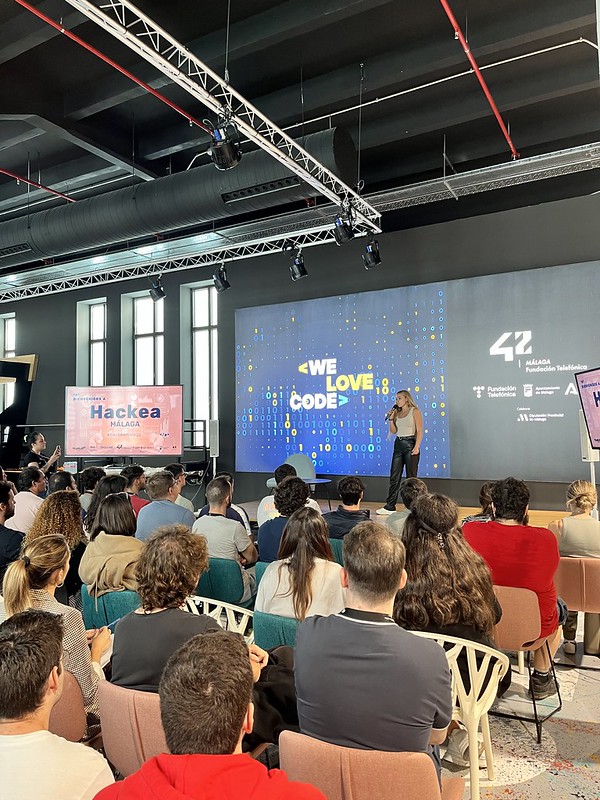
If you’re in Bachillerato in Madrid, Barcelona, or Málaga and feel pulled toward both technology and entrepreneurship, we invite you to discover LEINN firsthand at our Puertas Abiertas (Open House) events. It’s the best way to get your questions answered, meet current students, and see how this educational model works in practice.
Keep Reading
If this article was useful to you, we recommend also exploring what career paths look like after an entrepreneurship degree on the TeamLabs/ blog. You’ll discover what kinds of careers LEINNers build after graduating, which sectors hire them, and what sets them apart in the job market. You can also download the LEINN information dossier with full details about the degree, the selection process, and upcoming Puertas Abiertas events in Madrid, Barcelona, and Málaga.