






“Can you study a degree to become an entrepreneur?” Many high school students ask this when deciding what to do next. Maybe you’re asking it right now. And the doubt makes sense: for years people have repeated the idea that entrepreneurship is something you’re born with, an innate talent that can’t be taught in a classroom.
But entrepreneurship can be learned. The catch is that you don’t learn it from books and exams alone. You learn it by doing, by failing, by building real projects, and by tackling problems no manual can anticipate. So the real question isn’t whether a degree to learn entrepreneurship exists — it’s which degrees actually let you start companies while you study, not after you graduate.
In this article we explain what learning entrepreneurship really means, why many traditional degrees stop at theory, and which university programs let you build your own project from day one.
What does “learning to start a company” actually mean?
Before talking about specific degrees, let’s get clear on what entrepreneurship means. For many people it means opening a business or launching a tech startup. But it goes further than that: it’s a way of thinking and acting when you face problems.
Entrepreneurship means spotting opportunities where others see obstacles, making decisions with incomplete information, working in teams, managing limited resources, and learning constantly from mistakes. Those skills don’t develop by reading case studies in class. They develop through practice.
Learning to start a company for real means experiencing the full cycle: from having an idea to validating it with real customers, designing a business model, landing the first revenue, and managing a team. It’s moving from theory to action — and that’s exactly where many traditional degrees fall short.
The difference between studying business and starting one during your degree
Here’s the heart of the matter. Studying about companies is one thing. Building a company while you study is something else entirely. Let’s look at the differences:
Comparison table: Studying vs. Building
| Aspect | Business Studies (traditional) | Starting a company during your degree |
|---|---|---|
| Main focus | Theory and academic knowledge | Practice and real value creation |
| Learning type | Memorizing concepts and other people’s cases | Experimenting and solving your own problems |
| Assessment | Exams and academic papers | Project results and process learning |
| Experience at graduation | Theoretical knowledge with no practical application | Company built, real revenue, team managed |
| Handling failure | Failure hurts your grade | Failure is part of learning |
| Network | Classmates and professors | Entrepreneurs, investors, real customers, mentors |
Business Studies (traditional approach)
In degrees like Business Administration (ADE), Economics, or similar programs, you learn core concepts: accounting, marketing, finance, human resources. This knowledge is valuable and necessary. The problem is that in many cases all this training stays at the theoretical level. You memorize models, analyze existing companies’ cases, and solve problems on exams — but you rarely build anything of your own during those four years.
Starting a company during your degree (practical approach)
By contrast, some educational programs are designed specifically for you to build real entrepreneurial projects while earning your degree. You don’t study other people’s companies — you create your own. You invoice, win customers, fail, learn, and try again. The learning comes from direct experience, not just books.
This difference matters. You can graduate from a traditional business degree with excellent grades and still feel lost when you want to start a company, because you never had the chance to practice in a real environment.
Why don’t most degrees teach real entrepreneurship?
The main reason is pedagogical approach. Most traditional universities are designed to transmit theoretical knowledge in a structured way. Professors explain concepts, students memorize them, then apply them in exams or academic papers. That model works well for certain disciplines, but it doesn’t fit the nature of entrepreneurship.
Entrepreneurship is chaotic, unpredictable, and deeply experimental. You can’t learn to start a company just by listening to lectures about business models. You need to test ideas, talk to potential customers, pivot when something isn’t working, and manage the frustration of failure. That requires a completely different methodology.
On top of that, building a real company while studying means accepting risk, failing publicly, and spending time on projects that may not succeed right away. Not every educational institution is prepared to allow that level of uncertainty in its curriculum.
Practical skills that real entrepreneurship builds
When we talk about learning entrepreneurship in practice, we mean developing concrete skills that can only be acquired by doing. Here are some of the most important ones:
Validating ideas with real customers
Thinking your idea is good isn’t enough. You have to go out, talk to potential users, and discover whether you’d actually solve a problem that matters to them. This means pushing past the fear of rejection and learning to listen to honest feedback.
Team management and collaboration
Starting a company is rarely a solo journey. You need to work with other people, divide responsibilities, manage conflict, and keep the group motivated when things get hard. These leadership skills are built by leading real teams, not by studying leadership theories.
Making decisions under uncertainty
In the real world you don’t have all the information before you decide. You learn to make fast decisions with incomplete data, to prioritize tasks, and to accept that some of your choices will be wrong. The key is learning to course-correct quickly.
Resilience in the face of failure
Not every project works out. In fact, many fail. Learning to handle that frustration, draw lessons from the mistake, and keep going is one of the most valuable entrepreneurial skills there is. And it can only be learned by actually failing — not by reading about other people’s failures.
Basic financial management
When you manage a real budget, you learn fast how to track income and expenses, calculate margins, and understand what economic viability actually means for a project. Running a theoretical spreadsheet in class is a different experience from deciding how to invest the limited money you have for your project.
What kinds of degrees teach real entrepreneurship?
Still a minority, but growing: university programs that place practical entrepreneurship at the center of their methodology. Here’s what they look like:
Project-based methodology
Instead of organizing learning by traditional subjects, these degrees work by projects. Students form teams and develop real business initiatives from year one. Theoretical knowledge is introduced when it’s needed to move the project forward — not before.
Building companies during the degree
Students don’t simulate having a company — they actually create one. They register the entity, find customers, invoice, and manage all the legal and administrative aspects of a real business. By the time they graduate, they don’t just have a degree; they have experience as entrepreneurs.
Learning in diverse environments
Many of these programs include international stays in innovation and entrepreneurship ecosystems. Students work in other countries developing projects, meeting local entrepreneurs, and learning to adapt to different cultural and economic contexts.
Teams as the core of learning
Teamwork isn’t a side activity — it’s the foundation of everything. Students learn that building a company is a team sport, and they develop collaboration skills from the start.
Mentors and external experts
Instead of relying solely on academic professors, these programs connect students with entrepreneurs, investors, and industry professionals who bring real-world experience and genuine networks.
Examples of degrees that build real entrepreneurship
In Spain and other countries there are university programs designed specifically to develop entrepreneurs through practice. Here are some of the most notable options:
LEINN (Liderazgo Emprendedor e Innovación)
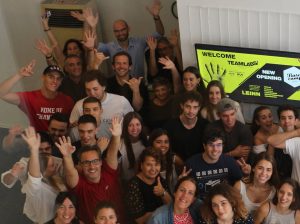
LEINN is a four-year official university degree where young people build real companies from day one. The methodology, born in Finland in 1993, is based on learning by doing and starting companies as a team. During the degree, LEINNers don’t just study business theory — they incorporate their own companies, find customers, and invoice.
LEINN also includes Learning Journeys to Finland, Costa Rica, South Korea, and India, where LEINNers develop projects in international ecosystems, practice intercultural commerce, and learn to adapt to high-complexity environments. By graduation, they have real entrepreneurial experience, a global network, and the confidence that comes from having created value in diverse contexts. The degree is certified by Mondragon Unibertsitatea and officially recognized by the Spanish Ministry of Education. It can be taken at the TeamLabs/ learning labs in Madrid, Barcelona, and Málaga.
Entrepreneurship programs at business schools
Some international business schools offer degrees or master’s programs focused on entrepreneurship with a strong practical component. These programs typically include startup incubators, pitch competitions, and access to investor networks.
University degrees with innovation tracks
Certain traditional universities have begun incorporating specific entrepreneurship tracks within degrees like Business Administration or Engineering. Although the approach remains largely theoretical, they include practical modules, idea competitions, and mentorship programs with entrepreneurs.
Bootcamps and intensive programs
Outside the traditional degree format, there are bootcamps and intensive entrepreneurship programs that, while they don’t award an official university qualification, offer highly practical training in short periods. They’re especially useful as a complement to a university degree.
LEINN: a concrete case of entrepreneurial learning
To understand better how a degree where you actually start companies works, let’s look at LEINN in more detail.
What makes LEINN different?
From day one, LEINNers organize into teams and start working on entrepreneurial projects. They don’t wait until year three or four to “do an internship.” Practice is constant, and it begins the moment they walk in the door.
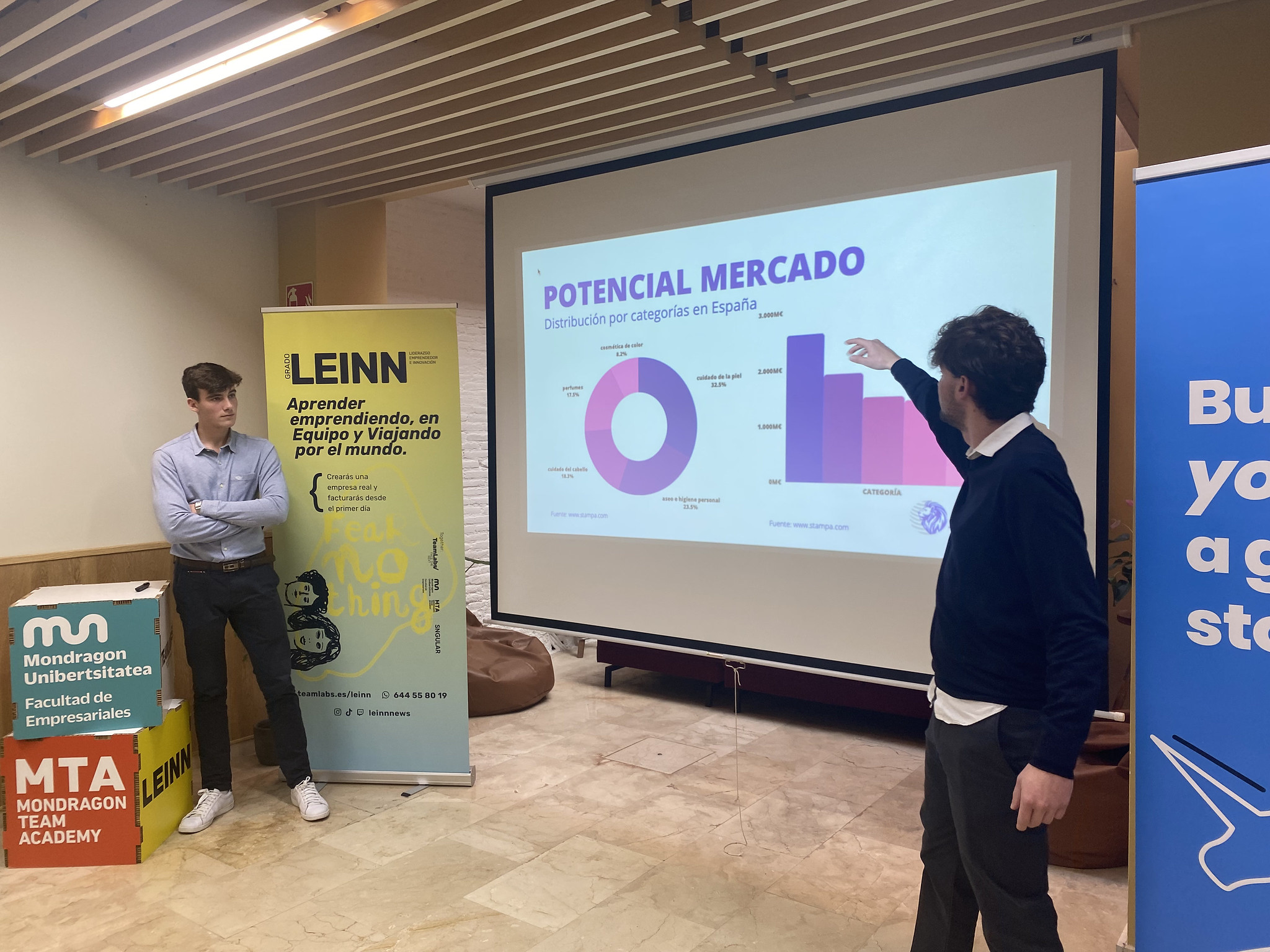
Over the four years of the degree, they build real companies, manage teams, invoice clients, and make business decisions with tangible consequences. Learning happens because they have to solve real problems — not theoretical exercises. You can see concrete examples of projects built by LEINN students to understand the kind of initiatives that take shape during the degree.
Learning Journeys
One of LEINN’s most distinctive elements is its international Learning Journeys. LEINNers spend time in countries across three different continents, developing projects in those ecosystems. For example, they can build a social initiative in Costa Rica to practice intercultural business in Latin America, work with tech startups in South Korea to engage with international trade in a high-complexity environment, or go to Finland to engage with the origins of the methodology and apply Team Learning principles in context. These aren’t educational tourism — they’re real immersions in diverse business ecosystems, each tied to a specific pedagogical purpose.
Lab culture
LEINN runs on a lab mindset: failure and experimentation are rewarded. LEINNers learn that making mistakes is part of the process, and that failure is a source of learning, not a source of shame. This culture is fundamental to building the resilience every entrepreneur needs.
Tangible results
The numbers speak for themselves. For example, the 100 young people studying LEINN in Málaga have built 7 companies and generated over €260,000 in revenue during their studies — proof of what real learning through action produces, not a promise of what you’ll earn.
Employment rate and professional future
LEINN has one of the highest employment rates of any degree in Spain. That’s because graduates don’t just have theoretical knowledge — they have verifiable practical experience. They’ve led teams, managed budgets, dealt with customers, and solved complex problems in diverse environments. These are exactly the skills that innovative companies and organizations are looking for. If you want to know more about the radical learning methodology that underpins this approach, you can explore how TeamLabs/ works as an educational institution.
Is an entrepreneurship degree right for you?
Before committing to a degree centered on practical entrepreneurship, it’s worth asking yourself a few questions:
Do you enjoy creating new things?
If you’d rather build your own projects than follow predefined instructions, this type of degree may be a good fit. Entrepreneurship requires initiative and a genuine desire to experiment.
Are you comfortable with uncertainty?
Starting a company means not having all the answers in advance. If you need absolute certainty before acting, you may prefer a more structured approach. But if uncertainty energizes you, entrepreneurship could be your path.
Do you see failure as a learning opportunity?
In these programs, making mistakes is part of the process. If you see an error as a chance to learn rather than a definitive failure, you already have the right mindset.
Do you enjoy working in teams?
Modern entrepreneurship is built on collaboration. If you enjoy working with other people, complementing skills, and solving problems together, this type of degree will sharpen that capacity.
Are you looking for learning connected to the real world?
If what you want from your university education is a direct impact on your ability to create value and solve real problems, practical entrepreneurship degrees are the most coherent option.
Frequently asked questions about degrees for learning entrepreneurship
Can I start a company if I study a traditional degree?
Absolutely. Many people start companies after graduating from traditional degrees, or even while studying on their own initiative. What entrepreneurship-focused degrees do is make the path easier by integrating that experience into the curriculum, rather than leaving it as an extra-curricular task.
Do I need a business idea before I start?
No. In fact, it’s better to start without preconceived ideas. During the degree you’ll learn methodologies for spotting opportunities, validating ideas, and pivoting when needed. The best ideas tend to emerge when you’re deep in the process, not before. Tools like Design Thinking and Lean Startup will help you generate and validate ideas systematically.
Are these degrees only useful if I want to start my own company?
Not necessarily. The skills you develop through entrepreneurship are also highly valuable if you work inside existing organizations, especially in innovation, business development, or project management roles. Many organizations look for profiles with an entrepreneurial mindset to drive internal transformation. In fact, educational institutions and companies collaborate with programs like LEINN precisely to bring in this kind of talent.
Is it harder than a traditional degree?
It’s not harder — it’s different. Instead of memorizing content for exams, your challenge is to solve real problems and create tangible value. Some people find this more motivating because they see concrete results from their effort.
What happens if my project fails during the degree?
Failure is part of the learning. In degrees like LEINN, mistakes are understood as opportunities to learn and improve. You don’t pass or fail based on whether your project achieves economic success — you’re assessed on what you learn from the process and how you apply that learning.
Conclusion
Learning to start a company for real isn’t about studying about businesses — it’s about building them. University degrees exist that are designed for you to develop real projects, invoice, manage teams, and face the challenges of entrepreneurship from day one. They’re not for everyone, but if you’re looking for practical training, connected to the real world, that prepares you to lead innovation projects, they may be exactly right for you.
Programs like LEINN show that it’s possible to combine an official university degree with the experience of building companies in teams, going on Learning Journeys to international ecosystems with clear pedagogical purpose, and learning by doing. By graduation, you won’t just have a degree — you’ll have verifiable experience, a real network, and the confidence of having created genuine value.
If you’re deciding what to study and entrepreneurship calls to you, explore these options. Talk to students already in these programs, attend an Puertas Abiertas Open House, and ask yourself whether this approach fits the way you learn and what you want for your future. The decision is yours — but now you know that learning to start a company for real is possible.