







What’s the difference between studying entrepreneurship and studying business? If you’re weighing which degree to pursue and you’re drawn to the world of business, you’ve probably already asked yourself this question. Both paths share the same broad territory, but they operate on completely different logic: one starts from analysis and theory; the other, from action and experimentation.
This isn’t really about which one is better in the abstract. What matters is understanding which learning model fits you and what kind of professional future you want to build. In this article we break down the most common stereotypes, explain the real differences between both approaches, and give you the tools to make an informed decision.
What does studying Business Administration (Spanish ADE) mean?
Administración y Dirección de Empresas, known in Spain as ADE, is one of the most popular degrees in the country. Its main goal is to train professionals who understand how business organizations work: from accounting and finance to marketing, human resources, and corporate strategy.
The approach is primarily analytical and theoretical. On one hand, you study cases of companies that already exist and learn conceptual frameworks for decision-making. On the other, you develop a broad view of how the business world operates. All of this unfolds within an ordered academic structure: courses, group assignments, and internships, typically in the third or fourth year.
What does ADE prepare you for?
ADE-style degrees primarily prepare you to work inside existing organizations: large companies, consulting firms, banks, multinationals, or public administration. It also provides a solid foundation for anyone who wants to pursue an MBA or specialize in specific areas like finance, digital marketing, or commercial management.
For example, if you picture yourself working in the finance department of a large company or leading the marketing team of an established brand, an ADE degree gives you the conceptual tools to get there.
What does studying entrepreneurship mean?
Studying entrepreneurship is a different thing entirely. The starting point isn’t a company that already exists — it’s the company you’re going to create. Learning is built on action: launching projects, testing them in the market, managing uncertainty, and learning from failure.
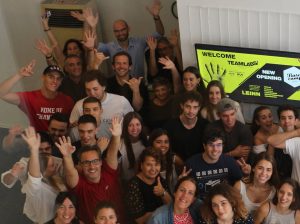
In the most advanced entrepreneurship degrees, like LEINN at TeamLabs/, there’s no business model to analyze from the outside. Instead, you’re the one building it from within, with real customers, real revenue, and decisions with real consequences from day one.
What kind of knowledge does the entrepreneurial approach develop?
The entrepreneurial approach develops what education specialists call procedural knowledge: knowing how to do, not just knowing how to explain. You spot market opportunities because you’ve been in the market. You lead teams because you’ve led one for real. And above all, you manage failure because you’ve experienced it and had to pivot.
All of this contrasts with the declarative knowledge that predominates in more traditional models: knowing what something is, being able to define it, and reproducing it in an assignment or exam. Both types of knowledge have value, but they prepare you for different things.
The myth that needs dismantling: “studying entrepreneurship isn’t a serious degree”
There’s a fairly widespread bias: that studying entrepreneurship is a less rigorous option than ADE or a traditional degree. That it’s for people who don’t want to work hard, who prefer to avoid structure, or who simply don’t know what they want to do.
This is false, and the data proves it.
The LEINN degree, for example, is backed by Mondragon Unibertsitatea and is an official university title recognized by Spain’s Ministry of Education. It’s not an entrepreneurship course or a bootcamp: it’s a four-year degree with rigorous university-level methodology.
What sets LEINN apart isn’t that it’s less demanding. It’s that it’s demanding in a different way: instead of memorizing theory for an exam, you have to build a real company, acquire customers, manage a team, and make decisions with real money on the line. That requires a level of commitment that goes far beyond passing courses.
In fact, the results are concrete and measurable. A LEINN team company of twenty people, by the end of their four years, will have generated a minimum of €300,000 in revenue and launched more than 30 to 40 projects to market. These aren’t simulations or case studies: they are real businesses operating in the real world.
What do you learn in each approach? The difference between entrepreneurship and Business Administration
To truly understand the difference between entrepreneurship and ADE-style degrees, the most useful thing is to compare which competencies each model develops over the course of the degree.
| Competency | Business Administration / ADE | Entrepreneurship (LEINN) |
|---|---|---|
| Business analysis | High. Cases, models, and organizational theory | Applied. You analyze your own company in real time |
| Company creation | Theoretical. Business plans on paper | Real. You register companies, find customers, and invoice |
| Managing failure | Failure is penalized in assessments | Failure is part of the learning process |
| Teamwork | Occasional, for group projects | Daily. Your team company is the core of learning |
| Leadership | Conceptual. Studied as a subject | Experiential. You practice it from the first year |
| Market contact | Internships in year 3 or 4 | From day one, with real customers and real invoicing |
| Tolerance for uncertainty | Low. Predictable academic structure | High. You work with open problems that have no single solution |
| International perspective | Optional (Erasmus, exchange programs) | Integrated. Learning Journeys across three continents |
The core difference: analyzing companies or creating companies
If we had to summarize the difference between entrepreneurship and Business Administration in a single sentence, it would be this: in ADE you learn to understand how companies work; in an entrepreneurship degree like LEINN, you learn to make them work.
This is not a value judgment. It’s a methodological difference with very concrete consequences for what you’re capable of doing when you graduate.
The traditional business model: analysis, cases, theory
The classic business approach is inductive: it starts from cases of successful or failed companies, analyzes them with conceptual frameworks, and extracts useful principles. It’s a highly valuable model, especially for understanding the business world from an academic perspective and for those who want to work as analysts, consultants, or executives inside existing organizations.
Its core strength is, without a doubt, conceptual depth. That said, the gap between theory and real practice can be significant, particularly if your goal is to start building from the very beginning.
The entrepreneurial model: action, market, failure
The entrepreneurial approach, by contrast, is more direct: it starts from a real problem, tests solutions in the market, and learns from the results. Theory doesn’t disappear, but it arrives when the project needs it, not before.
This model, which in LEINN is structured around the MTA Model (Mondragon Team Academy Model), has more than 30 years of history. It began in Finland and is now applied by Mondragon Unibertsitatea in Spain. In practice, learning is organized around the team company: a real company you create and manage as a team throughout the entire degree.
Its core strength is that when you graduate, you already have demonstrable experience. That said, it also demands a level of commitment and tolerance for ambiguity that not everyone is ready to embrace.
What type of student fits each approach?
This is perhaps the most important question of all. There is no objectively better degree: there is the degree that best fits how you learn, your goals, and your personality.
The profile that fits ADE best
ADE makes a lot of sense if you enjoy classic academic structure, if you’re drawn to working in analysis, finance, or consulting inside established organizations, or if you want a solid theoretical foundation before venturing into entrepreneurship later on. It also fits well if you value clarity about the steps ahead and find it more comfortable to learn first and apply afterward.
It’s also a highly versatile degree that opens doors across many different sectors. However, precisely because of that breadth, you may graduate without a clear specialization if you haven’t supplemented it with hands-on experience.
The profile that fits an entrepreneurship degree best
A degree like LEINN makes sense, first of all, if you already know you want to start a company or work in innovation environments. It’s also a good fit if you get bored quickly when theory has no immediate practical application, if you value learning by doing even when that means making mistakes along the way, and if you’re looking for real responsibility from day one.
On the other hand, you don’t need to arrive with a defined business idea. The degree doesn’t ask that of you: the learning process is designed so that you discover it as you go, while you’re actually building.
You can see the kinds of projects current students are creating on the LEINN projects page.
LEINN as an example of the entrepreneurial approach in Spain
LEINN (Liderazgo Emprendedor e Innovación) is the most established example of the entrepreneurial approach in Spanish university education. It’s an official four-year degree delivered through the TeamLabs/ learning labs in Madrid, Barcelona, and Málaga, backed by Mondragon Unibertsitatea.
What makes LEINN different from a Business Administration degree?
The most important difference is structural: in LEINN you don’t study to understand companies, you are the company. From the first year, you incorporate a team company with your team, seek out real customers, develop products or services, and manage budgets with real consequences.
The support throughout this process doesn’t come from traditional faculty. It comes from Team Coaches: professionals with entrepreneurial experience who help you reflect on what you’re experiencing in your company and ask you the right questions. They never tell you what to do. They help you figure it out yourself.
Technical knowledge, including finance, marketing, legal, and technology, is introduced through intensive workshops and sessions at the moment your project actually needs it. It doesn’t arrive as a course disconnected from reality.
Integrated international learning
One of LEINN’s defining features is its international Learning Journeys. Throughout the degree, you travel to countries across three continents to develop projects in entrepreneurial ecosystems very different from Spain: from the cooperative models of Finland, where the methodology was born, to the technology innovation environments of South Korea, and the social impact ecosystems of Costa Rica and India.
These trips aren’t optional or touristic: they’re part of the core learning experience. They expand your understanding of the global business environment, build your capacity to adapt to unfamiliar contexts, and develop an international network that few university degrees can match.
Measurable results
The figure that best captures LEINN’s approach is this: a LEINN team company of twenty people, by the end of four years, will have generated a minimum of €300,000 in revenue and launched more than 30 to 40 projects to market. These aren’t simulations or paper business plans: they are real businesses that have operated for four years, with real customers and real money.
As a result, when you graduate from LEINN you don’t just hold an official university degree. You also carry a portfolio of real projects, demonstrated competencies, and entrepreneurial experience you can show to any company, investor, or potential client.
Frequently asked questions about the difference between entrepreneurship and Business Administration
How is LEINN different from ADE?
LEINN and ADE are both official university degrees, but with very different approaches. ADE trains you to analyze and manage existing companies through a model built on theoretical coursework. LEINN trains you through the creation of real companies: from the first year you build a team company, find customers, and invoice while learning by doing. The support in LEINN comes from Team Coaches, not traditional faculty, and technical knowledge is introduced when the project needs it.
Can you start a company after studying ADE?
Yes, many entrepreneurs have studied ADE. The degree offers a useful conceptual foundation in finance, strategy, and business management. However, ADE isn’t designed to teach you to build a company from practice: you’ll learn a great deal about companies that already exist, but you won’t have created one during your studies. So if your main goal is entrepreneurship, a degree with a practical focus like LEINN can prepare you more directly for that path.
Is LEINN an official university degree?
Yes. LEINN is an official four-year university degree, recognized by Spain’s Ministry of Education and backed by Mondragon Unibertsitatea. It’s not an entrepreneurship course or a bootcamp: it’s a university qualification with the same academic recognition as any other degree. Specifically, it’s delivered through the TeamLabs/ learning labs in Madrid, Barcelona, and Málaga.
What’s the difference between entrepreneurship and Business Administration in terms of career paths?
ADE opens broad career paths: consulting, banking, finance, human resources, marketing, and management in large companies. Graduates of entrepreneurship programs like LEINN, by contrast, tend to move toward starting their own companies, working in startups, or taking on high-responsibility roles in organizations that value the entrepreneurial profile. Both paths offer strong employment outcomes, though in different contexts. In fact, LEINN has one of the highest employment rates in Spain, because companies value professionals with real entrepreneurial experience.
What type of person is better suited to studying entrepreneurship?
Primarily, people who learn better by doing than by studying theory, who get bored when they can’t see an immediate practical application, and who want real responsibility from day one. It also fits well for those who want to build companies or work in innovation environments, even if they don’t yet have a clear business idea. You don’t need to arrive with a defined project: the learning experience at LEINN is designed so you discover it as you go.
Conclusion: the difference isn’t about level, it’s about model
The difference between studying entrepreneurship and studying Business Administration isn’t a question of academic quality or which option is more demanding. It’s a difference in mental model and learning methodology.
ADE prepares you to understand, analyze, and manage companies that already exist. An entrepreneurship degree like LEINN prepares you to build companies from scratch, learn from the real market, and develop the mindset of an entrepreneur.
Neither is objectively better. The right question, then, isn’t which one is more valuable — it’s which one fits your way of learning, your goals, and the kind of university experience you want to have.
If you want to explore firsthand how LEINN’s entrepreneurial model works, the best way is to experience it in person. TeamLabs/ hosts open house events — Puertas Abiertas — in Madrid, Barcelona, and Málaga, where you can visit the learning lab, talk with current students, and see for yourself whether this model fits you before making any decision.
Check upcoming LEINN open house events at TeamLabs/ and come see it with your own eyes.
Keep reading
If this article was useful to you, we also recommend reading about career paths after an entrepreneurship degree and what day-to-day life as a LEINNer looks like. You’ll find practical information about the casting process, open house events, and a downloadable dossier with everything about the degree at TeamLabs/.