


By Félix Lozano, Co-founder and CEO of TeamLabs/
When TeamLabs/ turned 10, I wrote that we were:
“A simple, repetitive practice sustained over time, with rituals and tools that build the discipline of teams learning while working on projects they care about”.
Five years later, I still believe that is the best way to explain TeamLabs/.
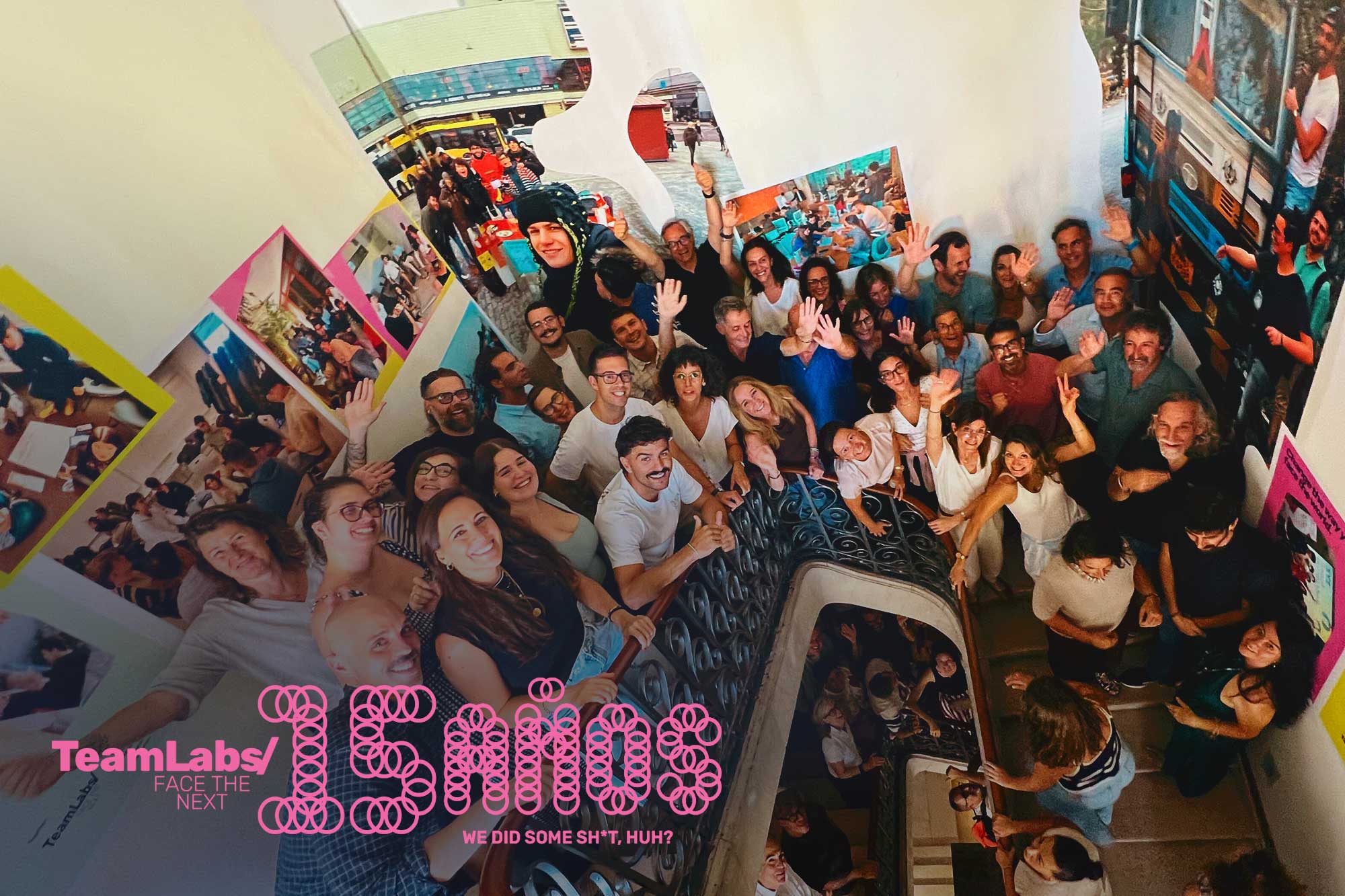
We could tell the story of these 15 years through the programs we have created, the cities where we have opened learning labs, the companies that have emerged, the organizations we have worked alongside, or the hundreds of people who have been part of our community. All of that belongs to our history, but it does not fully explain who we are.
Above all, TeamLabs/ is a practice sustained with determination and tested in the real world.
We did not design a theory first and apply it later. We began by doing in 2011. Since then, we have observed how we work, tried to understand what happens when it woks, and asked what needs to change when it no longer does. Is that not how artisans work?
Antonio Lafuente, a researcher at the Spanish National Research Council and a member of the TeamLabs/ Advisory Board, has once again helped me see this with fresh simplicity. In his view, this practice rests on three radical, innovative, and caring actions: working as a team, working experimentally, and working through self-assessment.
The first two are already contained in our name. TEAM expresses who learns. LABS expresses how they learn. Self-assessment completes the loop that turns experience into learning.
Learning to work as a team
At TeamLabs/, a team is not a way to divide up the work. It is where learning happens.
A team forces us to step outside ourselves. It confronts us with other ways of seeing, different abilities, conflict, interdependence, and the consequences of our decisions. It teaches us that having a good idea is not enough: we must learn how to build it together.
That takes practice. Teamwork does not emerge spontaneously just because several people sit around a table. It requires dialogue, shared responsibility, listening, high standards, and care. It also requires time. Slowness is not a burden; it is an asset, an ally, and a method.
After thousands of hours of practice, we have learned that a team that learns develops more than the ability to deliver projects. It acquires a mental model: a different way of understanding work and being in the world. It is a way of life with its own reward: the joy of sharing.
Learning to work experimentally
In our learning labs, we try to blur the boundary between university and business through two complementary movements: learning by doing, as a practical university does, and working by learning, as a learning organization does.
We do not work with exercises that simulate reality. We create projects, find clients, generate value, and face the consequences of our decisions. Ideas come into contact with the world, and the world responds.
Experimenting does not mean improvising. It means framing questions, exploring answers, acting tentatively, observing what happens, producing data, comparing information, detecting situations, making conjectures, testing responses, setting priorities, unlearning, and reframing. Again and again. We keep at it. It also means taking pleasure in assembling and dismantling, making and unmaking, building and taking apart. It means enjoying the process, to quote Antonio again, “as children, makers, and witches do”: with the freedom of play, the intelligence of the hands, and the boldness of unruly knowledge.
That is why we changed (Team) Academy to (Team) Labs when we began this adventure. We wanted to express that learning was not about receiving ready-made answers or off-the-shelf solutions. It was about daring to explore, test, make mistakes, make better mistakes, and try again. This is not a cycle of sacrifice. It is closer to a samba circle: joyful, shared, and vibrant.
Reality always knows more than our plans. Working experimentally means paying attention, learning to listen, allowing ourselves to be affected, and, above all, remaining open, finding joy in play, and working recursively.
Aprender a autoevaluarnos
The third practice is to pause, look at what we have done, and ask what we are learning and who we are becoming.
Self-assessment is not about giving ourselves a grade, judging ourselves kindly, or being excessively harsh. It is about comparing our intentions with the available evidence, listening to how others see us, and taking responsibility for our own process.
This practice turns experience into learning. Doing many things does not guarantee that we learn from them. To learn, we need to review, interpret, receive feedback, and reshape our next action. We need to make mistakes, make many mistakes, and make better mistakes.
We also need to develop our own judgment. Young people who have had access to more opportunities, in particular, need to ask what they will do with their abilities, whom their work will serve, and which problems truly deserve their energy.
When a degree designs the university
University degrees are usually designed by universities. Their content, methods, and assessment systems pass through faculty boards, academic processes, and institutional dynamics that reflect a particular understanding of higher education.
It is less common for the reverse to happen: for the learning experience of a degree to transform the institution that must make it possible.
I like to think that this is, to a large extent, what has happened at TeamLabs/. We did not first build an organization and then make LEINN fit inside it. The practice of LEINN has continually pushed us to create the context its learning requires.
If the team is where learning happens, the organization must learn to trust teams. Given that projects are real, the boundary between studying and working must become more permeable, and as learning requires experimentation, spaces, professional roles, time, and assessment must also change. And if each new experience challenges what we thought we knew, the institution itself must remain open to redesign.
This is how our Radical Learning Lab has taken shape. Not as a container for a degree that had already been completed, but as an organization shaped by the needs, tensions, and discoveries of its own educational practice.
LEINN does not only transform the people who take the degree. It also transforms those of us who try to make it possible.
This is one of the deepest convictions we have developed over these 15 years: we transform ourselves so that we can accompany processes of transformation.
A practice that has learned to name itself
Our nine Practicable Principles were not written down when TeamLabs/ began. They emerged as we observed what we practiced and recognized what was present when we were most faithful to ourselves.
We have learned that we are Lab, Learning, and Radical; that we transform through Team, Entrepreneurship, and Learning; and that all of this can only be sustained through Dialogue, Community, and Time.
They are not tools, although they should produce tools. Nor are they values to hang on a wall. They are criteria for examining how we work and asking whether it resembles what we claim to be. If we cannot recognize them in our habits, rituals, and decisions, then they really do risk becoming empty jargon.
Five years ago, I wrote that our next decade would be about intensifying the practice that had brought us this far: teams that learn throughout life within a laboratory culture. Today, my answer is not very different.
Fifteen years on, TeamLabs/ remains a collective and experimental project. We work openly, collaboratively, and with care in the midst of the world: on reality, from reality, and with reality, so that we can change it for the better. Yes, we say that with pride. We make the enduring principle our own: to understand something, we must dare to change it. We want things to change, and we care deeply that they change for the better.
Fifteen years on, our purpose remains the same: learn in order to undertake, and undertake in order to learn. It is not immediate, but it should be joyful. It takes time, support, and experimentation. Our practices are not armchair exercises; they happen in the street. A classroom can be anywhere, and the world is our lab. Our community has updated Kant’s “sapere aude” – dare to know – as “discere aude”: dare to learn.
We have not finished building TeamLabs/. We never will. Always in beta, under construction. Provisional, unfinished, and recursive. Always learning, with everything still to unlearn.
We keep practicing.