



What is a Team Coach in LEINN? It is the person who accompanies your learning process as an entrepreneur. Without giving you the answers, they help you find them on your own. If you’re exploring the official LEINN degree (Liderazgo Emprendedor e Innovación) and wondering who guides you when knowledge is built through doing rather than memorizing, this role is the key to understanding the model.
When many families and Bachillerato students discover that LEINN doesn’t follow a traditional teaching model, a very logical question comes up: “So who actually teaches you?” The answer is that in LEINN you don’t need someone to transfer content to you — you need someone to accompany you while you discover it through practice. That person is the Team Coach.
In this article we explain in detail what a Team Coach does, how they differ from a traditional university professor, where the role comes from in the Finnish Tiimiakatemia methodology, and why this figure is fundamental to your development within LEINN, the official university degree offered by TeamLabs/ and Mondragon Unibertsitatea.
What Is a Team Coach? A Clear Definition
A Team Coach is the professional who accompanies student teams throughout the entire LEINN degree. They do not deliver theoretical content or evaluate through written tests. Their primary function is to facilitate learning through questions, dialogue, and reflection, helping each team extract lessons from their own entrepreneurial experiences.
In other words: while a traditional professor tells you what you need to know, a Team Coach helps you discover what you need to learn from what you are experiencing in your real project. It is a role of accompaniment, not instruction.
This way of understanding education has a very specific origin. The Team Coach role was born at Tiimiakatemia (Team Academy), a pioneering program created in 1993 at the JAMK University of Applied Sciences in Jyväskylä, Finland, by Johannes Partanen. Since then, this methodology has been forming entrepreneurs in teams for over 30 years and has expanded to more than 12 countries. In Spain, Mondragon Unibertsitatea adopted and adapted this model through the Mondragon Team Academy Model (MTA Model), which is the pedagogical foundation of LEINN at the TeamLabs/ learning labs in Madrid, Barcelona, and Málaga.
What a Team Coach Does NOT Do
To understand this role clearly, it is equally important to know what they do not do. This is where the most common confusion is dispelled:
- They do not deliver theoretical content to the group: the Team Coach does not prepare presentations to transfer knowledge. Knowledge is built through doing, not memorizing. When your team needs specific technical training (finance, marketing, legal), workshops and sessions with subject-matter experts are activated.
- They do not assign numerical grades: assessment in LEINN is continuous and competency-based, not built around memorization tests. The Team Coach participates in the assessment process, but does not “give grades” in the traditional sense.
- They do not tell the team what to do or make decisions for them: if your team company is stuck with a difficult client or a project that isn’t working, the Team Coach will not hand you the solution. They will help you analyze the situation and build the capacity to find solutions, but the decision and the responsibility are yours and your team’s.
- They do not follow a predefined syllabus: each session with the Team Coach starts from what the team is actually experiencing at that moment, not from a fixed content program. Learning adapts to what your project needs.
This approach can be surprising if you’re coming from Bachillerato, where someone maps out every step for you. In LEINN, you build the path yourself, and the Team Coach makes sure you are learning as you walk it.
What a Team Coach DOES Do in LEINN
If the Team Coach doesn’t instruct or direct, what exactly do they do? Their work goes much deeper than it appears at first glance:
Facilitating Reflection on Experience
Experiential learning doesn’t happen just by doing things — it happens when you reflect on what you have done. The Team Coach guides that reflection. After your team launches a product, closes a deal with a client, or navigates an internal conflict, the Team Coach facilitates sessions where the team analyzes what happened, what worked, what didn’t, and what can be learned for the next time.
Asking the Right Questions at the Right Moment
One of the most important skills of a Team Coach is knowing what to ask and when. These are not rhetorical questions — they are questions that push you to think more deeply: Why did you make that decision? What would you have done differently? What is the market telling you with this data? These questions push you to develop your own business judgment.
Working on Team Dynamics and Health
In LEINN, your team (the team company) is the core of everything. The Team Coach observes how the group functions, detects tensions, identifies unproductive dynamics, and helps the team manage its own conflicts. They don’t resolve those conflicts for you, but they give you tools and space to address them constructively.
Connecting Practice to Knowledge
When your team faces a specific challenge — for example, how to set prices for your service — the Team Coach can point to readings, theoretical frameworks, or references that help you contextualize what you are going through. They don’t give you a lesson on pricing, but they guide you toward the resources you need at that moment.
Accompanying Personal Development
Beyond the company, the Team Coach pays attention to the personal growth of each team member. Is there someone who hesitates to speak up in meetings? Someone who always wants to lead without listening? Someone who avoids conflict? The Team Coach works with the team so that each person becomes aware of their own patterns and can evolve.
The Origins of the Team Coach: Tiimiakatemia and Over 30 Years of Methodology
The Team Coach role is not a recent invention or an educational trend. It has deep roots in one of the most recognized entrepreneurial education experiences in the world.
In 1993, in the Finnish city of Jyväskylä, marketing professor Johannes Partanen decided to radically transform how entrepreneurship was taught. Instead of continuing to deliver content in a classroom, he proposed that students create real companies and learn by managing them. This is how Tiimiakatemia (Team Academy) was born — a program where faculty stopped transmitting and started accompanying. The “professor” became a Team Coach.
The results speak for themselves. After more than three decades, 96% of Tiimiakatemia graduates in Jyväskylä are active in the labor market within six months of graduating, and nearly 40% are entrepreneurs. The methodology has expanded to more than 12 countries and has trained thousands of Team Coaching professionals.
In Spain, Mondragon Unibertsitatea adopted this model and developed it through the Mondragon Team Academy Model (MTA Model), which integrates the Finnish philosophy with the Basque cooperative tradition. LEINN is the official university degree that applies this methodology at the TeamLabs/ learning labs in Madrid, Barcelona, and Málaga. When you enroll in LEINN, your first Learning Journey takes you to Finland, where you experience firsthand the origin of the entire model — immersing yourself in Team Learning and the source of the methodology.
In fact, the LEINN Team Coach is trained through specialized programs such as TEAMINN Mastery, an international program accredited by Mondragon Unibertsitatea that combines the original Finnish methodology with the development of the MTA Model.
Differences Between a Traditional Professor and a Team Coach in LEINN
This is probably the most useful comparison if you come from the traditional education system and want to understand at a glance how the role of the person accompanying you changes:
| Aspect | Traditional professor | Team Coach in LEINN |
|---|---|---|
| Primary function | Deliver theoretical content | Accompany learning through experience |
| Relationship with students | Hierarchical: who teaches and who learns | Horizontal: accompanies as a guide, not an authority |
| Main tool | Content delivery and theoretical materials | Questions, dialogue, and facilitation of reflection |
| Assessment | Written tests and academic assignments | Continuous assessment based on competencies and real evidence |
| Content | Follows a closed, predefined syllabus | Adapts to the real needs of the team and its project |
| Role when problems arise | Explains how to solve them | Helps the team find its own solutions |
| Ultimate goal | Students master the course content | Each person develops judgment, autonomy, and entrepreneurial competencies |
In short, the traditional professor is the center of the teaching process. The Team Coach, on the other hand, places the team and the entrepreneur at the center — and their job is to make that center work.
Are Team Coaches the Only Support? Other Accompaniment Roles in LEINN
The Team Coach is the central figure, but not the only person accompanying you during the degree. LEINN has a complete support ecosystem that reinforces your learning from different angles:
- Mentors: professionals and entrepreneurs with real-world experience across different sectors who work with you at specific moments. They bring market perspective, connections, and concrete business insight that complements the Team Coach’s accompaniment.
- Advisors and subject-matter experts: when your project needs specialized technical knowledge (legal, financial, technological, design), you access workshops and sessions with professionals in that area. These are activated when your team needs them, not according to a fixed academic calendar.
- Graduate network: LEINN has an active community of people who have already completed the degree and are now working in companies, startups, or their own projects around the world. This network functions as support, inspiration, and real professional connection.
- Your own team: in LEINN, your team company peers are also a constant source of learning. Much of the growth comes from peer feedback, shared management, and collective building.
So the question is not “Who teaches you if there are no traditional faculty?” — it is “How many people and resources do you have available to learn?” The answer is: far more than you imagine.
What Does a Session with Your Team Coach Look Like?
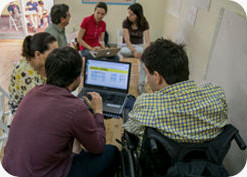
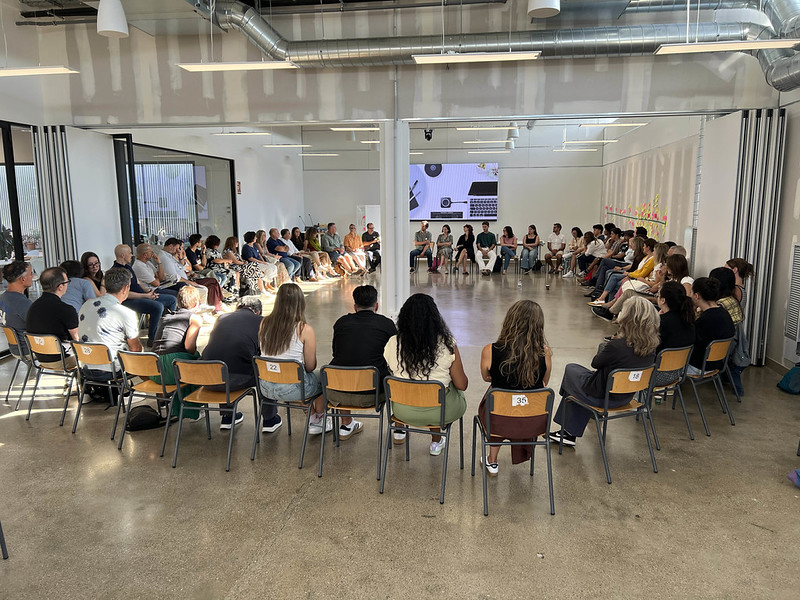
To give you a concrete sense of it, here is what a typical accompaniment session with the Team Coach in LEINN looks like: the full team (your team company, usually around 20 people) meets with the Team Coach several times a week, normally in two weekly sessions. These sessions are called training sessions and typically last between two and four hours.
There are no slide presentations or notes to copy. The usual format is a circle dialogue where the team shares what is happening in their projects, the challenges they are facing, the decisions they have made, and the results they have obtained. The Team Coach facilitates that conversation, making sure the dialogue goes deep enough, that topics are addressed from different angles, and that useful lessons are extracted.
For example, imagine your team has just lost an important client. In a session with the Team Coach, the dialogue might explore: Why did the client leave? What signals did you miss? How did you handle the communication? What does that say about your business model? What would you do differently next time? The Team Coach does not give you the answers, but makes sure you find them yourselves.
These sessions are the space where experiential learning comes alive: you experience something in your company, reflect on it with your Team Coach and your team, conceptualize what you have learned, and apply it again in the next project.
Frequently Asked Questions About the Team Coach in LEINN
How Many Team Coaches Are There per Team in LEINN?
Each team company (entrepreneurial team) has a designated Team Coach who accompanies them on a stable, ongoing basis. However, over the four years of the degree you may work with different Team Coaches depending on the stage and the team’s needs. In addition, during international Learning Journeys — such as the one to Finland in year one, Costa Rica for Team Learning in Latin America in year two, and South Korea and India for international trade and high-complexity environments in year three — you also interact with coaches and facilitators from other contexts.
Do LEINN Team Coaches Have Real Entrepreneurial Experience?
Yes. The people who work as Team Coaches in LEINN combine specific training in team coaching — many through the TEAMINN Mastery program accredited by Mondragon Unibertsitatea — with real professional experience in entrepreneurship, team management, or innovation. These are not purely academic profiles: they are professionals who know the reality of the entrepreneurial world and can connect your experience to meaningful learning.
Can You Change Team Coaches During the Degree?
Yes, it is common to work with more than one Team Coach over the four years of LEINN. This happens naturally according to the degree’s stages and can be beneficial because each Team Coach brings a different accompaniment style and perspective. The goal is for your team to always have the most appropriate accompaniment for the phase it is in.
What Training Does a LEINN Team Coach Have?
LEINN Team Coaches are trained through specialized programs that combine the original Finnish Tiimiakatemia methodology with the Mondragon Team Academy Model (MTA Model). The reference program is TEAMINN Mastery, an international program in team coaching and learning facilitation accredited by Mondragon Unibertsitatea. Hundreds of people have completed this program over the past decade.
If There Are No Traditional Faculty, Is the LEINN Degree Official?
Yes, LEINN is an official university degree from Mondragon Unibertsitatea (University of Mondragon). The fact that the methodology is different does not mean the credential is not official. When you complete LEINN you receive a university degree with full academic and professional validity in Spain and throughout the European Union.
Conclusion: The Team Coach Is What Makes Learning by Doing Possible
The Team Coach is the piece that completes the LEINN puzzle. Without this figure, a model based on entrepreneuring as a team from day one would lack the structure of reflection and accompaniment necessary to turn experience into real learning.
When someone asks “If LEINN has no traditional faculty, who teaches you?”, the most accurate answer is: you teach yourself through experience — but you are not alone. You have a Team Coach who ensures that every project, every mistake, every success, and every conflict becomes an opportunity for deep learning.
This model is not new or experimental: it has over 30 years of demonstrable results in Finland and has been successfully adapted in more than a dozen countries. In Spain, through the Mondragon Team Academy Model (MTA Model) and the TeamLabs/ learning labs, this approach is part of the LEINN degree in Madrid, Barcelona, and Málaga.
If you want to see up close how Team Coach accompaniment works and what it is really like to learn by entrepreneuring as a team, the best way is to experience it yourself. Come to the Puertas Abiertas (Open House) events at TeamLabs/ in Madrid, Barcelona, or Málaga, talk to current students, and see for yourself whether this learning model is right for you.
Keep Reading
If you found it useful to understand what a Team Coach is in LEINN, we recommend reading our article on what day-to-day life in LEINN looks like, where you’ll discover in detail how a typical week is organized, how sessions with your Team Coach work, and what kinds of real projects you develop throughout the degree.