In an environment of constant and rapid change,
Either you are willing to lose yourself or you are lost. Learning -facing unknown challenges naturally and confidently, without fear of not knowing- is the infallible tool for adapting, reacting, anticipating and staying competitive.
Learning -and doing it quickly- accelerates the transformation of organizations and their capacity for innovation. For this reason, the culture of learning is elevated to a strategic business pillar. But people don’t acquire a learning mindset with training.
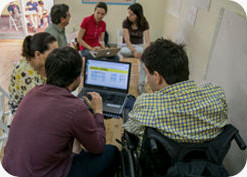
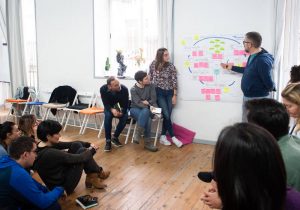
They train it as a team, in real projects, in laboratory contexts that encourage self-management and experimentation.
For this reason, we create radical learning laboratories to inoculate
in corporations a culture of entrepreneurship and innovation. A laboratory where working with real projects is the basis for obtaining new skills, tools and ways of working that can be extended throughout the company. Thus, causing a real capacity to innovate and intrapreneurship as a team.
The objective of the Radical Learning Lab (RLL) is to promote innovation projects that have an impact on the growth of companies. Create and extend a learning culture that converts innovation into a new way of working for teams.
A Radical Learning Lab (RLL) is a connection space between the strategic challenges of the organization and the talent necessary to solve them.
All with a double objective: Obtain implemented solutions; and Form and transform teams and ways of working through a learning strategy.
This is specified in 5 elements that make up the RLL:
01/ RLL governance model. Own ODR management and direction forums that guarantee the orientation of the challenges and the viability of the solutions.
02/ Areas of Opportunity. Strategic foci for the organization from where concrete challenges can be drawn to propose to the work teams.
03/ Community and Entrepreneurial Teams. A community of internal talent, complemented by LEINNERS, who are assigned the challenges to solve.
04/ Work and learning process. A detailed process so that the teams can solve the proposed challenges and reflect on the lessons learned along the way.
05/ Propagation spaces. Meeting forums with the rest of the organization to promote a culture of learning by sharing the different projects and their results.